Replace, Augment, Protect: The Three-Word Framework Driving Enterprise Restructuring in 2026
The Boardroom Pivot
Enterprise C-suites are experiencing an unprecedented forcing function. In May 2026, the structural transformations sweeping through technology pioneers are no longer viewed by institutional boards as isolated tech-sector anomalies. Instead, they are being scrutinized as operational blueprints for the modern corporate entity.
When Cloudflare restructures its workforce, cutting approximately 20% of its headcount to systematically reduce "measurer" roles in favor of "builders" and "sellers," and ClickUp deploys roughly 3,000 internal AI agents across its organization, creating a 3:1 aggregate agent-to-employee ratio while introducing million-dollar salary bands for employees who demonstrate outsized impact through AI, enterprise boards take note. Private equity sponsors, activist investors, and corporate directors will be if they are not now, pressing CEOs, CFOs, and CIOs to match these efficiency benchmarks or defend their legacy cost structures.
The question dominating enterprise strategy is no longer if an organization should adopt autonomous technology, but how to transition to an AI-native operating model without triggering systemic operational failure.
What Your Clients See: The Restructured Enterprise
For mid-market and enterprise leadership teams, these structural shifts illuminate a profound realignment of organizational design. Executives are navigating a delicate dichotomy: intense enthusiasm for unprecedented margin expansion countered by acute anxiety over breaking legacy workflows and inciting cultural mutiny.
The core of this transformation lies in the dismantling of human-heavy middleware. Both Cloudflare CEO Matthew Prince (in a Wall Street Journal op-ed accompanying the restructuring) and ClickUp CEO Zeb Evans (in his public post on X) converge on a strikingly similar framework: enterprise architecture is shifting away from traditional layered hierarchies toward an optimized triage of corporate talent.
The chart below maps this new blueprint. Read left to right to see the spectrum from "fully automated" to "fully human." Read top to bottom to see the progression from "who are they" to "so what."
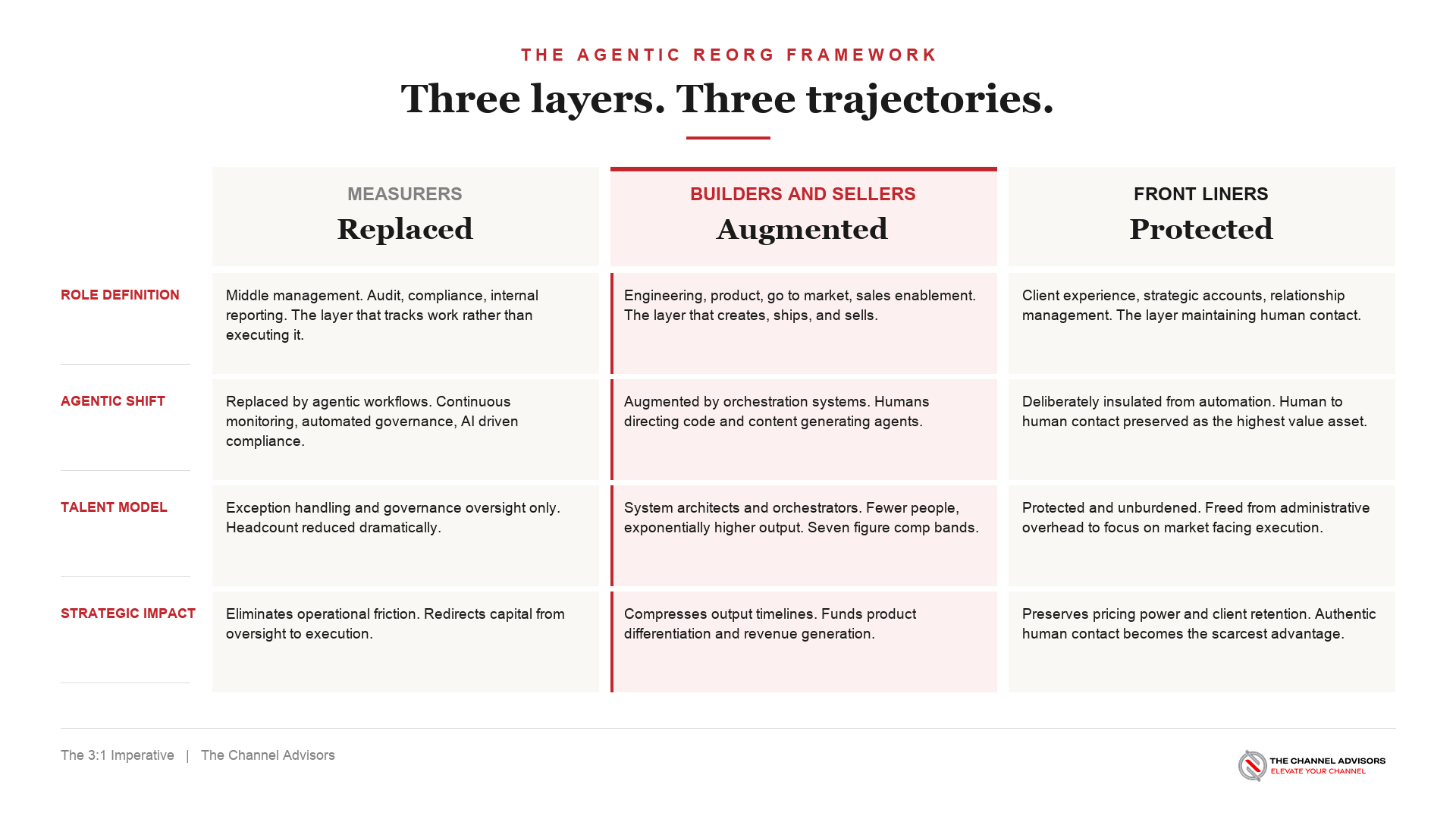
The Executive Dilemma
Your clients recognize that traditional middle management, the "measurers" who track, report, and control, can now be outperformed by tireless, objective AI systems. Yet, they are right to be cautious about execution risk. Replacing functional middleware with thousands of interconnected autonomous agents introduces immediate challenges around data governance, prompt drift, and cultural resistance. The transition itself carries real cost: retraining, severance, organizational redesign, and the engineering capacity required to build and maintain agentic infrastructure that most mid-market companies do not yet possess.
A Note on the Numbers
ClickUp's 3:1 ratio reflects an aggregate company-wide statistic: approximately 3,000 AI agents deployed across roughly 1,000 remaining employees after a 22% workforce reduction. It is not a per-person operational design target. Not every human has three dedicated agents reporting to them. The ratio describes the density of autonomous tooling embedded across the entire organization: engineering, marketing, support, and executive operations.
This distinction matters. When enterprise boards hear "3:1 agent ratio," they tend to imagine a clean, per-seat allocation. The reality is messier and more powerful. Some workflows are agent-dense. Others remain entirely human. The strategic question for your clients is not "how many agents per person" but "which workflows can absorb agent density and which ones cannot."
The TA Conversation Script: Leading the Reorg QBR
Technology Advisors cannot afford to approach upcoming Quarterly Business Reviews (QBRs) with standard infrastructure optimization pitches. If you are merely selling network plumbing while your client's board is demanding a structural overhaul, you will be bypassed by management consultancies eager to own the multi-million-dollar budgets driving the agentic transition. You must command the architecture of this transition, or at minimum, position yourself as the implementation partner to help those companies needs.
When executing your next QBR with a CIO or CEO, bypass tactical software features and pivot directly to structural design. Use this diagnostic framework to capture strategic control of the account:
The Opening Concept: "John, looking at the market shifts this quarter, specifically how Cloudflare eliminated roughly 20% of its workforce by reclassifying roles into builders, sellers, and measurers, and how ClickUp deployed 3,000 AI agents while introducing million-dollar comp bands for high-impact orchestrators, your board is likely asking how to mirror those business outcomes. Let's step away from standard procurement and look at your architecture through the lens of an AI-native operating model. I want to examine three core vulnerabilities in your current structure."
1. The Middleware Audit: Where are you funding "measurers" over "builders" and "sellers"?
The Context: Cloudflare's restructuring, detailed in Prince's WSJ op-ed, proved that compliance, internal reporting, and middle management are tracking friction points that agentic systems optimize more precisely than human capital. Prince framed the shift explicitly around AI's capacity to outperform human measurement functions.
The Diagnostic Question: "If we map your current payroll against Prince's three-category model, what percentage of your human capital is dedicated to tracking and controlling work rather than executing or selling it? How do we build an architectural roadmap to automate those tracking layers and free up capital to fund your highest-impact builders and sellers?"
2. The Bottleneck Paradox: Is your increased volume creating systemic friction?
The Context: As organizations deploy AI coding and content engines, they frequently celebrate dramatic increases in output. However, without agentic middleware to handle review, quality assurance, and routing, this volume simply creates a human bottleneck at the approval stage. Evans described this dynamic directly: ClickUp is measuring efficiency gains by "gamifying value created and time saved" rather than raw token consumption.
The Diagnostic Question: "As we scale AI tools across your engineering and marketing divisions, where is the resulting volume bottlenecking your senior managers? How do we transition your best talent from manual reviewers to system managers who orchestrate agent networks, the same role ClickUp is now compensating at seven figures?"
3. The Human Premium: Which workflows are explicitly ring-fenced for human interaction?
The Context: In an environment saturated with automated communication, authentic human contact becomes an enterprise's scarcest, high-value asset. ClickUp explicitly protected its "front-liner" roles because relationship management cannot be replicated by an LLM. This was a deliberate structural decision, not an afterthought.
The Diagnostic Question: "As we aggressively automate your back-office and middle-tier operations, have we clearly isolated and ring-fenced the high-touch, human-to-human workflows that preserve your pricing power and client retention? Let's design an infrastructure that unburdens your front-line teams so they can focus entirely on market-facing execution."
Sources
Cloudflare: Matthew Prince, Wall Street Journal op-ed and internal memo, May 2026. Approximately 1,100 employees (20% of workforce) affected. Framework: Builders, Sellers, Measurers.
ClickUp: Zeb Evans, post on X, May 2026. 22% workforce reduction (approximately 290 employees). 3,000 internal AI agents deployed. Covered by TechCrunch (Marina Temkin, May 25, 2026) and Fortune.
Gartner: Survey finding that approximately 80% of companies using autonomous tech have cut jobs, though workforce reductions are not necessarily translating into meaningful financial returns.
The Bottom Line
Technology Advisors who proactively introduce this structural diagnostic framework decouple themselves from commodity brokerage and claim a definitive role in enterprise organizational design. Those who remain silent will find their portfolios absorbed by consultancies and systems integrators eager to control the agentic transition budgets their clients are already allocating.