The Tractor Did Not End Work, It Ended a Kind of Work
I keep hearing the same sentence in different rooms. AI is going to take this job. Sometimes it comes out as a joke, sometimes it comes out as a real fear, but it is in every conversation right now.
Before anyone panics, look at the numbers. There is a 220 year experiment that already ran this exact scenario, and it did not happen in a data center. It happened on a farm.
In 1800, about three out of four American workers farmed for a living. Today that number sits around one percent. The population grew more than sixty times over in the same window, and somehow food got cheaper, safer, and more available the whole way through. The field hands left the field, and nobody starved.
Here is the actual shape of that shift.
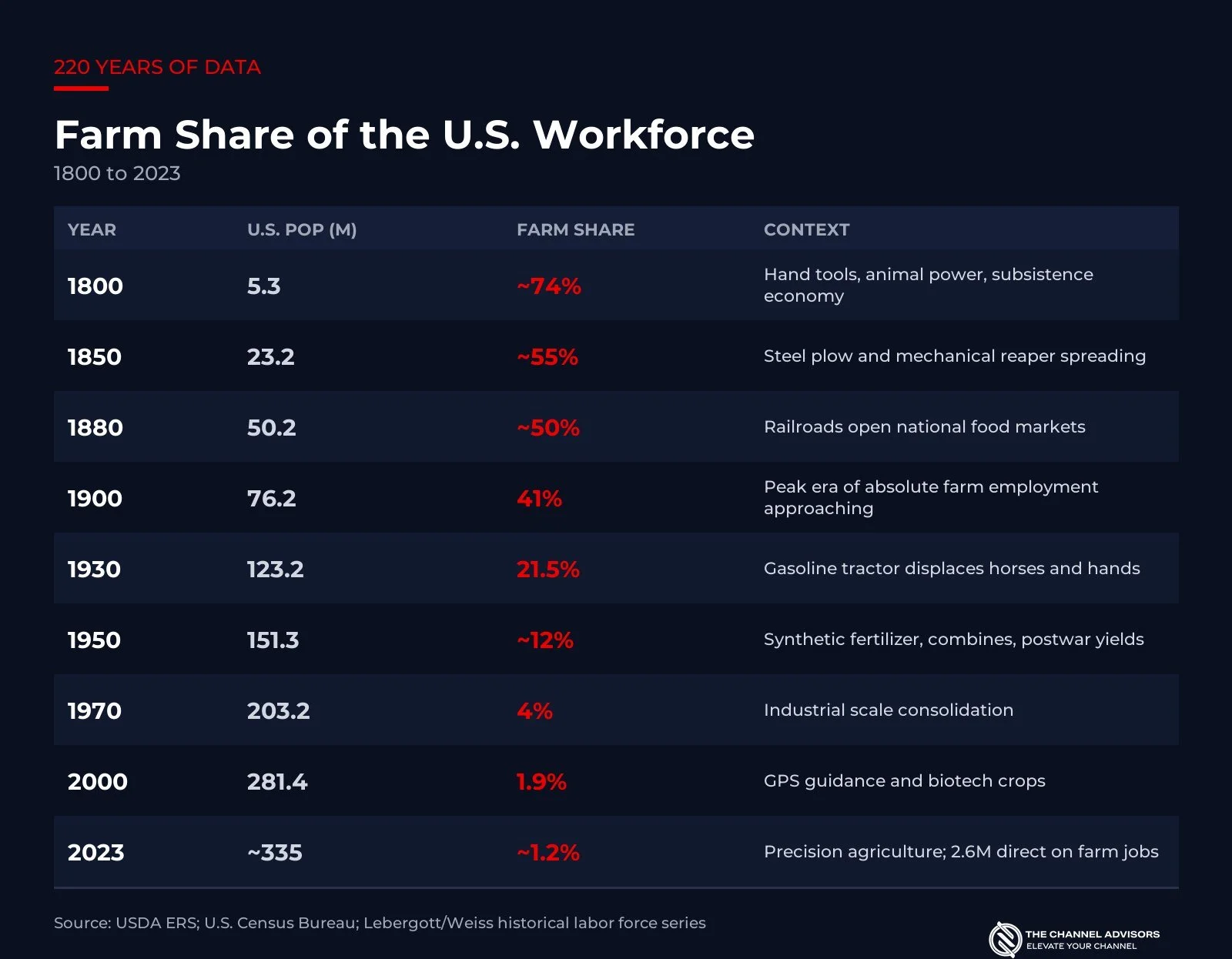
Look at that bottom row. About 2.6 million people work directly on farms right now, feeding 335 million Americans and a good chunk of the rest of the world besides. The other 98.8 percent of us went and did something else with our lives. We are not sitting around unemployed. We built most of what you'd call the modern economy in the space farming used to take up.
Why this actually works
Here is the mechanism, and it is simpler than people make it sound. When technology gets good enough to solve a problem, the cost of that problem drops, and the people who used to be needed for it go find the next problem.
Take the family budget. In 1901, a household spent roughly 40 percent of its income on food. Today that number is closer to 11 percent. Nearly 30 points of every paycheck got freed up over a century, and that money went somewhere. It funded cars, healthcare, air travel, entertainment, software. None of those industries could have existed at scale while most of a family's income was going straight into keeping itself fed.
Time followed the same path. Dawn to dusk labor on a farm turned into a 40 hour workweek. Leisure went from something a subsistence farmer had almost none of to a industry worth trillions on its own. Vacations, hobbies, streaming, live events; all of it downstream of labor that agriculture no longer needed.
The lesson underneath all of it: work does not run out. Human wants keep expanding. Solve one problem well and the labor and capital that used to sit on it moves to whatever problem is next in line, which is just what two centuries of data show happening, over and over.
Every wave looked like the end while it was happening
The tractor was not the first technology to trigger this fear, and it will not be the last. The steel plow and mechanical reaper in the 1840s cut hand labor needs at a scale that felt brutal at the time. Railroads in the 1880s blew up local food monopolies and reshaped entire regional economies almost overnight. The gasoline tractor in the 1920s caused the single sharpest labor displacement in the whole data set, wiping out horses and the human labor built around them faster than anything before or since. Synthetic fertilizer and the combine harvester did it again in the 1950s. GPS guidance and precision agriculture did it again in the 2000s, quieter this time, because by then the pattern had already repeated three times over.
Let's not just sugar coat this though. Real people lost their value in real skills in every one of these waves. Transitions like this are hard on whoever gets caught in the middle of them, and they were always hardest on the people who waited too long to move. The ones who struggled were rarely struggling because the new technology failed them. They struggled because they were slow to adapt to it.
But look at what happened after every wave. Total employment went up, not down. Every time.
What this means for the channel
Here is where the history lesson turns into your actual job.
The trusted advisor was never the field hand in this story. The advisor is the one deciding what the tractor gets pointed at.
What gets automated first is what always gets automated first: quoting, provisioning, commission reconciliation, data lookup, first draft everything. The repeatable, solved parts of the work. That is the tractor doing what tractors do.
What gets more valuable is harder to automate because it was never mechanical in the first place. Trust the customer built with you over years, not with a tool. Experience that tells you which answer actually fits this account instead of which answer is technically correct. Real fluency in how the technology works, not just what it does, so you can catch the moment it is about to get misapplied. The ability to integrate that technology into a customer's business instead of just installing it and walking away. And a grip on the business outcome the customer actually needs, which was always the point of the relationship and was never something a quote or a spec sheet could capture on its own.
Buy the tractor first
The farmers who came out ahead in 1930 did not have better land than their neighbors. They bought the tractor while everyone else was still arguing about whether it was a passing trend.
That is the choice sitting in front of the channel today. AI is already changing what the job requires. The real question is whether you decide what it gets used for early, or you find out the hard way later.
Drop a farmer from 1800 into today's world and his math says 99 percent of us should be starving, because that is what it would take for this many people to leave the fields where he lived. Instead we are pilots, therapists, security analysts, technology advisors. The labor that got freed up did not disappear. It built things he had no way to imagine.
The channel is standing in that same spot right now. The tools are changing what the job asks of you. They are not making the customer stop needing someone they trust to stand behind the outcome.
Here is what I keep coming back to. Every wave in this history had people whose skills went out of date, and most of them figured that out on their own, too late, with nobody in their corner to tell them it was coming. The TSD channel does not have to repeat that part of the story. We are positioned closer to this shift than almost anyone, we can see it coming before it lands, and that puts a responsibility on us that goes past our own accounts. The technology advisors, the reps, the operations people whose day to day work is about to change, they need someone telling them straight what is coming and pointing them toward the skills that will matter next. That is on us. Not because it is charity, but because it is the same job we have always done, just aimed one step earlier than usual.
Sources
USDA Economic Research Service, Ag and Food Sectors and the Economy: https://www.ers.usda.gov/data-products/ag-and-food-statistics-charting-the-essentials/ag-and-food-sectors-and-the-economy
USDA Economic Research Service, The 20th Century Transformation of U.S. Agriculture and Farm Policy, Economic Information Bulletin No. 3: https://www.ers.usda.gov/publications/pub-details?pubid=44197
Bureau of Labor Statistics, 100 Years of U.S. Consumer Spending, Report 991: https://www.bls.gov/opub/100-years-of-consumer-spending.pdf
U.S. Census Bureau, historical national population totals: https://www.census.gov/data/tables/time-series/dec/popchange-data-text.html
Stanley Lebergott and Thomas Weiss, standard economic history estimates for pre 1900 farm share of the labor force, used because official BLS series do not begin until 1948.